
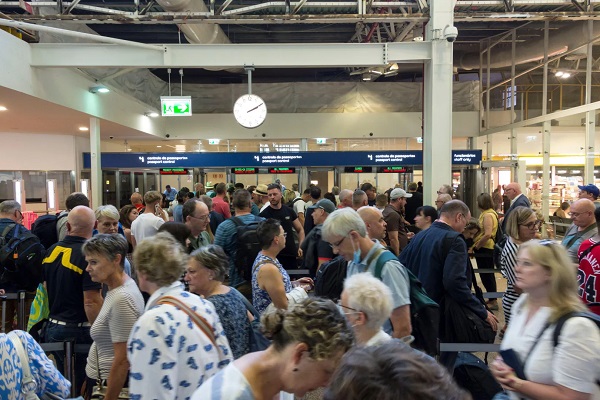
 Biometric checks for all passengers arriving in Portugal from outside the Schengen area have been running for a week, with the process operating smoothly at most Portuguese airports, with Faro the notable exception.
João Ribeiro, deputy national director of Portugal’s Public Security Police (PSP) and head of its National Foreigners and Borders Unit (UNEF), told journalists this week that biometric checks were currently being carried out “smoothly” across the country’s airports, although Faro was experiencing “greater pressure”.
At Lisbon airport, passengers previously took between five and 15 minutes to process when there was an option to suspend biometric checks. That has now risen to between 15 and 30 minutes, Ribeiro claimed.
The situation at Faro has been affected by several factors, including weather conditions and air-traffic delays. Last week, these are alleged to have caused several peaks in arrivals to coincide, with more than 10 flights landing at the same time, according to Ribeiro.
Since 6 September, Portuguese airports have been required to collect biometric data, including photographs and fingerprints, from eligible passengers. The checks form part of the European Union’s Entry/Exit System (EES), which began its phased rollout in October 2025.
Long queues and delays, particularly at Lisbon Airport, had been visible for several months, with passengers at times forced to wait for hours. The situation began to improve in May.
Ribeiro attributed the change to investment in technology, the reorganisation of airport areas to improve passenger flows, and an operational reinforcement that brought 360 additional officers to Portugal’s air border force.
Despite the biometric system now operating at full capacity, the UNEF chief said the European Commission had allowed member states to suspend biometric checks in the event of technological problems until December.
The UNEF has increased its staffing over the past year. A total of 1,504 police officers are now working on airport security and border control across Portugal: 706 in Lisbon, 325 in Porto, 215 in Faro, 115 in Madeira, 124 in the Azores and 19 in Beja.
Even with the additional personnel, however, the unit is currently operating at around 80% of its recommended staffing level.
The next priority, Ribeiro said, is to invest in more specialised personnel with the expertise to detect fraudulent documents and identify potential migration risks before they emerge.
Faro has experienced some of the worst disruption linked to the introduction of the EU’s new biometric border system. During the spring and summer of this year, passengers arriving from outside the Schengen area reported waits of two to three hours at passport control, while Algarve tourism operators said drivers had sometimes been left waiting four or five hours for clients to clear the border. The problem was particularly acute when many flights arrived together, creating sudden surges at immigration. The temporary suspension of biometric checks during periods of severe congestion provided some relief: on one occasion in April, when the EES system was unavailable, a traveller reported clearing passport control in about 40 minutes, compared with waits of three hours or more during peak periods when the system was operating.
Source: LUSA
Photo credit: Irish Sun


